
Mini Chapter Four

Put-Call Parity

Put-Call Parity – is a key zero-arbitrage concept in the European options world which explains that the total payoff of taking opposite directions on a put and a call option on the same underlying at the same strike price (even if different from the current market price) is the same as the payoff of either going long or short a forward contract on the underlying at that strike price. Hence the difference between the premium on the call and a put is equal to the difference between market price and the discounted value of the strike. Consider the below:
  • Pc = call option premium, Pp = put option premium, B = current market price, X = strike price, present value has continuous discounting at the risk free rate = Xe-rt
  • Long Call and Short put at strike X can be entered by paying (Pc – Pp)
  • At any time in the option tenor up to maturity, payoff on this strategy would be B – Xe-rt (note at maturity t = 0)
  • Payoff on a long outright forward position at strike X at any time during and upto the maturity of the position would be exactly the same.
  • The zero arbitrage on the above return profiles is the basis of Put Call Parity denoted by the following equation: Pc – Pp = B – Xe-rt


    Graph 7 – Payoff diagram – cover both scenarios of long/short Call vs Short/long Put
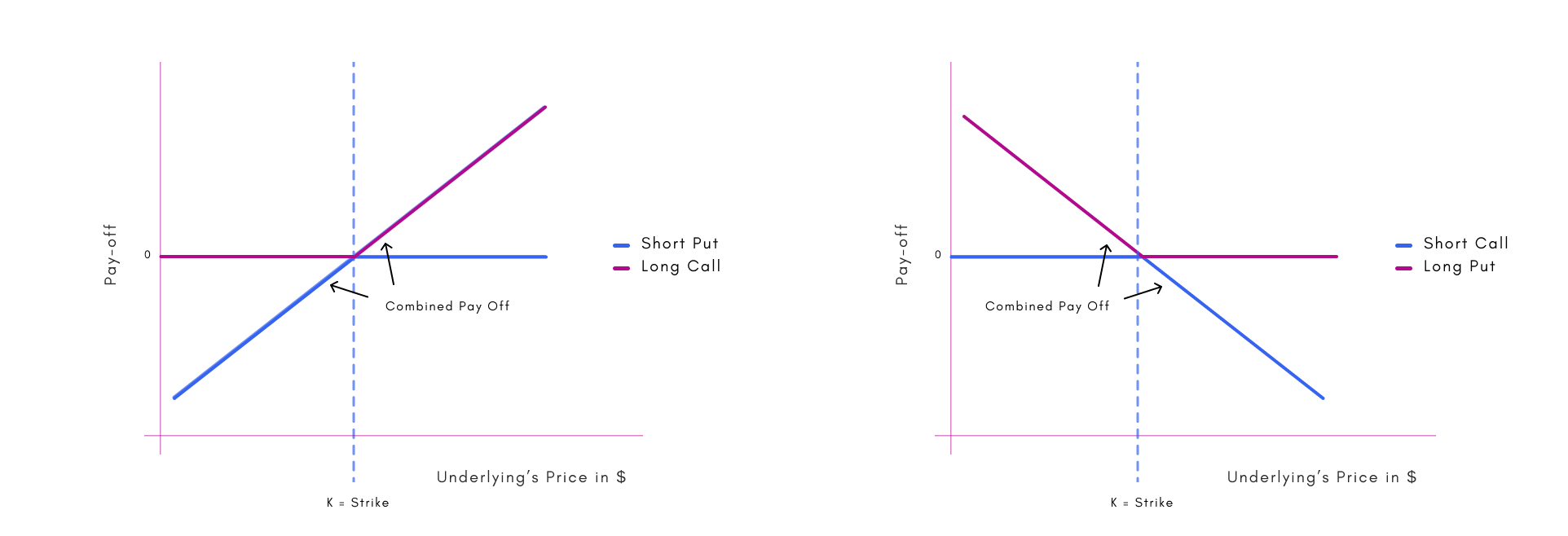
Source: Pandemonium.

  • As a follow-up to the above one can rearrange the equation and conclude for instance that the value of a portfolio composed of LHS should equal the value of a portfolio composed of RHS:
    • Long Call option + Long Strike = Long underlying at current market price + Long Put
    • Also as a corollary if the strike chosen (i.e. present value of the forward price discounted at r) is the same as the current market price, then the price of call is the same as the price of put.


Related Resources

For best reading experience please use devices with the latest versions of macOS or Windows on a chrome browser.

1: Stochastic Processes

Option contracts - are an arrangement entered between two parties where the buyer has the right but not the obligation...

Read More

2: Pricing of an Option

Pricing of an Option - Most pricing models calculate the price of an option using some form of hedging such that the portfolio of the option...

Read More

3: Intuition behind Black Scholes

Black Scholes option pricing equations for a European Call ( C ) and European Put (P)

Read More

5: Let’s speak Greek(s)

Option Greeks - risks embedded in an option contract that appear with movements in its variables and determine...

Read More

6: Volatility and its smiles

Implied vs Realised Vol - an extensively used term for the options world and one that crucially determines an option’s price...

Read More

7: Delta and Gamma Hedging

As a concept means neutralising the sensitivity of an option’s price due to change in the price of the underlying stock.

Read More

8: How Greeks adapt to smiles

Hedging and valuation of the option portfolio also crucially depends on the vol model assumptions...

Read More

9: Straddles

While it's hard to lay out watertight rules for structuring strategies (as markets can throw unimaginable circumstances)...

Read More

10: Strangles

This is a cheaper variation of a straddle that involves going long an OTM put and an OTM call again usually structured...

Read More

11: Bull Spread

Generally structured as buying a lower strike (base case at the money) call and selling a higher strike...

Read More

12: Bear Spread

Generally structured as buying a higher strike put and selling a lower strike put for the same expiry and same notionals...

Read More

13: Calendar spreads

Is a strategy to go short time decay by selling a shorter expiry option and buying a longer expiry one...

Read More

14: Risk Reversal

Risk reversals involve either selling an OTM Put and Buying an OTM call or Buying an OTM Put and Selling an OTM call...

Read More

15: Butterfly

A long butterfly spread involves buying a call (i.e. a call fly) each at a lower strike and higher strike while selling 2 calls...

Read More

16: Digitals

Are a binary payoff strategy - i.e. payoff is either zero or the notional of the trade - conditional on the underlying’s price trading...

Read More

17: Regular and Reverse Barriers

These options officially fall in the realm of structured products as they can be understood as a combination of at least two different options...

Read More

You cannot copy content of this page